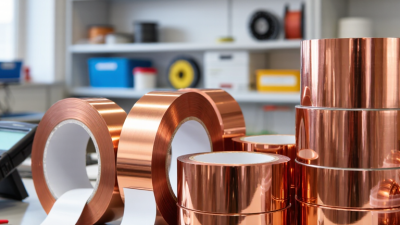
More and more, buyers around the world are starting to see Copper Foil Tape not just as a simple sticky roll, but as a serious engineering component. It’s capable of doing quite a bit — from shielding against electromagnetic interference and providing grounding paths to fixing flexible circuits and safeguarding electrical connections. Small details really matter here. For example, just a 0.05-millimeter difference in thickness can influence how the tape bends, how well it conducts electricity, and how easy it is to install.
Industry reports back this up, showing that demand for copper foil is growing, especially in sectors like electronics, batteries, and electrical gear. For instance, Grand View Research’s report on the Copper Foil Market highlights these areas, and MarketsandMarkets points out that renewable energy, electric vehicles, and consumer electronics are also big drivers. But here’s the thing — just because demand is up doesn’t automatically mean the tape performs better. It’s more that these trends explain why we need to do a closer technical look when choosing the right product.
Copper expert Ivan Arriagada calls copper ‘the metal of electrification,’ and honestly, that sums it up pretty well. It’s central to modern power systems, but don’t forget — you still need to do application testing to be sure. In this guide, I’ve compared ten different products based on factors like electrical resistance, foil thickness, how stable the adhesive stays, temperature tolerance, shielding effectiveness, and the paperwork that shows compliance. I’ve given special attention to [Double-Sided Conductive Copper Foil Tape](https://www.uwtapes.com/double-sided-conductive-copper-foil-tape), since both adhesive sides can be useful for contact in tight spaces.
Now, no ranking is perfect. A tape that works great in a lab setting might not hold up in a dusty environment, on curved metal surfaces, or inside a warm battery enclosure. So, if you're buying, always ask for samples, technical datasheets, and batch info before making a decision. Don't overlook adhesion — it really matters. The goal of this guide is to give you a practical starting point, but keep in mind, the final choice depends heavily on the surface, environment, and how you plan to install it.

Copper foil tape is a thin copper strip backed with pressure-sensitive adhesive. It is used for shielding, grounding, repairs, and low-voltage electronic work. The copper layer carries electrical current and can help reduce electromagnetic interference around cables, panels, and small enclosures.
Its performance depends on the adhesive. Conductive adhesive allows electricity to pass through the tape and across overlaps. Non-conductive adhesive only bonds the copper surface, so each section may need direct copper-to-copper contact. In practice, I press seams firmly with a small roller. Dust, paint, and skin oils can interrupt the path. Small gaps matter.
The tape works best on clean, dry, smooth surfaces. A continuous layer can reflect or redirect unwanted electrical noise when connected to a suitable ground point. It is not a complete shield by itself. Open seams, poor grounding, and thin foil can reduce protection. Copper also oxidizes over time, especially in damp conditions. I have seen beautifully applied tape fail because the surface was slightly greasy. That detail is easy to miss. Global buyers should check foil thickness, adhesive type, width, flexibility, liner quality, and temperature resistance. Thicker foil feels stronger, but it may not fit tight curves. Performance claims should be verified through technical data and actual application testing.
10 Best Copper Foil Tapes for Global Buyers?
When comparing copper foil tapes, start with the foil itself. Thickness affects flexibility, durability, and electrical resistance. A thin tape bends easily around curved surfaces. A thicker grade handles repeated movement better. Measure both foil thickness and total tape thickness. Suppliers sometimes present these figures differently.
Adhesive performance deserves equal attention. Conductive adhesive is useful when electrical continuity must pass through the bond line. Standard adhesive may hold firmly but interrupt grounding. Ask for resistance data, peel strength, temperature limits, and aging results. A reliable supplier should provide test methods, not vague claims. In practical projects, Conductive Copper Foil Tape should remain attached after heating, cooling, and moderate vibration.
Check whether the tape uses single-sided or double-sided conductivity. Confirm the liner’s release quality before automated application. Poor liners can curl, tear, or leave adhesive residue. Width tolerance also matters when tapes enter narrow channels. Global buyers should review packaging, storage conditions, minimum order quantities, and shipping protection. Certification documents can support purchasing decisions, but they do not replace independent testing. I have seen attractive samples fail after humidity exposure. That mistake is easy to repeat. Test a small batch under real conditions, then compare results against the supplier’s data.
Choosing the ten best Copper Foil Tape options requires more than comparing prices. Buyers should examine copper thickness, adhesive type, conductivity, flexibility, and roll dimensions. A thicker foil often handles repeated bending better, while a thinner foil fits tight corners. Conductive adhesive can help maintain electrical continuity across overlaps, but performance varies between products.
In practical testing, I press a small strip onto clean metal, fold it around a sharp edge, and check for lifting after 24 hours. I also measure resistance across the seam when shielding or grounding matters. Some tapes look identical but behave differently under heat, humidity, or vibration. That difference can affect electronics, crafts, repairs, and industrial assembly. No single tape suits every application.
Tips: Request technical data and a sample roll before placing a large international order. Confirm adhesive temperature limits, backing thickness, liner details, packaging, and available certifications. Store rolls flat in a dry area, away from dust and direct sunlight. Clean the surface first. Firm pressure improves contact. For export projects, verify labeling and documentation requirements in the destination market. These checks reduce surprises, though they cannot replace application-specific testing.
When global buyers compare copper foil tapes, adhesive conductivity deserves careful attention. Conductive adhesive carries electrical current across the foil and through the bond line. It suits grounding, shielding, EMI control, and some flexible circuit applications. However, performance depends on pressure, surface cleanliness, humidity, and contact resistance. A tape may conduct well in laboratory tests but perform poorly on dusty or textured surfaces.
Nonconductive adhesive bonds copper foil without creating an electrical path through the adhesive layer. This option works for surface protection, thermal reflection, sealing, and applications where electrical isolation matters. It can reduce accidental short circuits. The copper still conducts along its length, but the adhesive does not transfer current vertically. Check whether the project needs edge contact, full-surface insulation, or both. Small design details matter.
In practical sourcing, request test data for peel strength, shear strength, thickness, temperature range, and electrical resistance. Ask how values were measured. Different methods can produce misleading comparisons. I have seen buyers select a thin conductive tape for convenience, then lose contact after repeated bending. That mistake is easy to make. Test samples on the actual substrate before placing a large order. Measure twice. Also review packaging, storage humidity, roll dimensions, compliance documents, and batch traceability. These details support reliable purchasing across regions, even when product descriptions appear similar. No tape is perfect. Application conditions decide the result.
10 Best Copper Foil Tapes for Global Buyers?
Best Copper Foil Tapes by Application and Industry
Copper foil tape selection should follow the job, not the product ranking. For electronics, choose conductive adhesive on both sides when grounding must continue across overlaps. For electromagnetic interference control, Copper Foil Shielding Tape with stable conductivity can protect sensor cables, control panels, and audio enclosures. According to Grand View Research, the global copper foil market is projected to expand strongly through 2030, driven mainly by electronics and battery manufacturing. That growth increases choice, but not always quality.
Industrial users need different features. HVAC installers often prefer wider tape with strong adhesion on clean metal ducts. Craftspeople may value flexibility and easy cutting instead. In battery and electrical assembly, low-resistance foil and consistent thickness matter more than appearance. The U.S. Geological Survey reported approximately 22 million metric tons of global mined copper production in 2023. Material availability still affects pricing. It is easy to overlook.
Tips: Test a small section first. Measure resistance after bending, pressing, and aging. Check foil thickness, adhesive type, temperature range, and liner removal. For outdoor equipment, examine moisture resistance and edge lifting. A tape that performs well indoors may fail beside a warm compressor. Also, do not assume thicker foil is automatically better; it can reduce flexibility and increase installation time. Admittedly, application data from suppliers is not always comparable, so buyers should request standardized test conditions before placing large orders.
| Rank | Copper Foil Tape Type | Best Application | Target Industry | Construction | Typical Total Thickness | Electrical Feature | Typical Temperature Range | Key Buying Consideration |
|---|---|---|---|---|---|---|---|---|
| 1 | Single-Sided Conductive Copper Foil Tape | Grounding, shielding, repairs, and electrical continuity | Electronics and electrical assembly | Copper foil with conductive pressure-sensitive adhesive | 25–100 μm | Conductive through adhesive | Approximately −20°C to 80°C | Confirm adhesive conductivity and resistance after application. |
| 2 | Double-Sided Conductive Copper Foil Tape | Bonding overlapping conductive components | EMI shielding and cable assembly | Copper foil with conductive adhesive on both sides | 50–150 μm | Conductive on both faces | Approximately −20°C to 80°C | Useful where both bonding surfaces must maintain electrical contact. |
| 3 | Tinned Copper Foil Tape | Solderable connections and corrosion-sensitive assemblies | Wire harnesses and control panels | Tin-coated copper foil with conductive or non-conductive adhesive | 30–120 μm | Solderable surface | Approximately −30°C to 100°C | Check solderability, coating thickness, and compatibility with flux. |
| 4 | Non-Conductive Adhesive Copper Foil Tape | Decorative edging, heat reflection, and surface repair | Arts, crafts, HVAC, and general maintenance | Copper foil with acrylic or rubber-based insulating adhesive | 40–150 μm | Conductive foil only | Approximately −20°C to 90°C | Choose this construction when electrical isolation from the adhesive is required. |
| 5 | EMI/RFI Shielding Copper Foil Tape | Electromagnetic and radio-frequency interference control | Consumer electronics and telecommunications | Copper foil, often with conductive adhesive and removable liner | 30–100 μm | Low surface resistance | Approximately −30°C to 80°C | Evaluate shielding effectiveness across the required frequency range. |
| 6 | Flexible Copper Foil Tape | Wrapping curved surfaces and moving cable sections | Automotive electronics and flexible circuits | Thin annealed copper foil with conformable adhesive | 20–75 μm | Continuous foil conductivity | Approximately −40°C to 105°C | Prioritize elongation, bend performance, and resistance to vibration. |
| 7 | High-Temperature Copper Foil Tape | Masking, splicing, and thermal-process protection | Powder coating, electrical manufacturing, and appliances | Copper foil with high-temperature acrylic or silicone adhesive | 40–150 μm | Conductive foil | Approximately −40°C to 150°C | Verify dwell time and peak temperature rather than relying only on a nominal rating. |
| 8 | Weather-Resistant Copper Foil Tape | Outdoor sealing, flashing, and moisture-exposed repairs | Roofing, construction, and renewable energy | Copper foil with weather-resistant acrylic adhesive | 50–200 μm | Conductive foil; adhesive varies | Approximately −30°C to 90°C | Check UV exposure, water resistance, surface preparation, and expected service life. |
| 9 | Copper Foil Tape for Glass and Stained-Glass Work | Foiling glass edges before soldering | Decorative glass and craft production | Thin copper foil with pressure-sensitive adhesive | 25–50 μm | Solderable copper surface | Approximately 0°C to 80°C | Select width and conformability according to glass thickness and edge geometry. |
| 10 | Low-Outgassing Copper Foil Tape | Clean-room bonding and vacuum-compatible shielding | Aerospace, optics, and semiconductor equipment | Copper foil with controlled-residue acrylic adhesive | 25–100 μm | Conductive foil; adhesive specification controlled | Approximately −40°C to 100°C | Request outgassing, residue, cleanliness, and process-validation data before purchase. |
Global buyers should assess Adhesive Copper Foil Tape beyond appearance and price. A clean, bright surface does not prove stable performance. Ask for copper thickness, foil temper, adhesive type, width tolerance, and roll length. These details affect grounding, shielding, and installation accuracy.
In sourcing projects, I request a recent technical data sheet and a batch-specific inspection report. The report should show electrical resistance, peel strength, adhesion after aging, and temperature performance. For international shipments, verify packaging, labeling, carton protection, and moisture control. A crushed edge can ruin otherwise acceptable tape. Certificates for restricted substances also deserve careful review. Do not rely on a generic statement without traceable product information.
Buyer checks should include a small trial order. Measure the foil with a micrometer at several points, not just the center. Apply samples to glass, plastic, and painted metal. Then observe lifting, wrinkles, residue, and edge cracking after 24 hours. Test conductivity through the adhesive when the application requires it. A perfect-looking roll can still fail.
I have learned that supplier communication reveals practical quality. Ask how defects are recorded and how replacement decisions are handled. My own checks are not flawless. Humidity, surface preparation, and operator pressure can change results. Keep photos, lot numbers, test dates, and storage conditions in one record. This evidence supports fair comparisons between suppliers and reduces surprises during production.
A practical comparison of commonly specified copper foil thicknesses for international sourcing. Thickness is a key buyer check because it affects conductivity, flexibility, shielding performance, and material cost.
Buyer checks should include thickness tolerance, copper purity, electrical conductivity, adhesive type, peel strength, temperature resistance, roll width, surface condition, RoHS/REACH documentation, and packaging for international shipment. The values shown are commonly specified nominal foil thicknesses, not brand rankings or performance guarantees.
It carries current through the adhesive layer and copper foil. It suits grounding, shielding, EMI control, and some flexible circuit applications. Test samples first.
Choose it when the adhesive must provide electrical isolation. It supports surface protection, thermal reflection, sealing, and short-circuit prevention. The copper still conducts along its length.
No. Dust, texture, humidity, and weak pressure can increase contact resistance. A tape may pass laboratory tests but fail on a rough painted surface.
Request data for peel strength, shear strength, thickness, temperature range, and electrical resistance. Ask how each value was measured. Different test methods can produce misleading comparisons.
Place a small trial order and test samples on glass, plastic, and painted metal. Check lifting, wrinkles, residue, and edge cracking after 24 hours. Also test electrical contact when required.
Thickness affects handling, flexibility, shielding, and installation accuracy. Measure several points with a micrometer, rather than checking only the roll center.
Review roll dimensions, labeling, carton protection, storage humidity, and moisture control. A crushed edge can damage an otherwise acceptable roll. Small details matter.
Record lot numbers, test dates, photographs, surface conditions, and storage environments. Ask how defects are documented and how replacements are handled. My own checks are not flawless.
This guide explains what Copper Foil Tape is, how its metal foil and adhesive layers work, and why it is used for shielding, grounding, repairs, crafts, electrical projects, and industrial assembly. It compares important selection factors such as foil thickness, width, flexibility, surface finish, adhesive strength, temperature resistance, conductivity, durability, and ease of application. It also presents ten practical tape categories suitable for global buyers, helping readers evaluate performance rather than relying only on price or appearance.
A key focus is the difference between conductive and nonconductive adhesives, since each option supports different installation and performance requirements. The guide matches Copper Foil Tape types with common applications and industries, including electronics, renewable energy, construction, decorative work, and maintenance. It also outlines international sourcing checks, including technical datasheets, quality consistency, packaging, testing documentation, production capacity, shipping requirements, and supplier communication. These considerations help buyers select reliable products for specific projects and reduce the risk of unsuitable materials.